From Parenting to Parent-Being

“I wish my child had come with a user manual.  Parenting is possibly the most important and challenging task put in the hands of amateurs without any training.  I didn’t sign up for this.  I should have read the fine print before committing to having a child.” 

Those are the words I’ve often heard from parents.  They make me ponder about my own journey as a father over the last two decades – a thrilling adventure packed with excitement, challenges, and joy.
Becoming a parent is easy.  Human beings are biologically-wired to procreate.  No training is required.  What isn’t always easy, is being a parent.  And I believe a huge part of the difficulty is attributable to the over-emphasis on ‘parenting’ and under-emphasis on ‘parent being.’  Let me elaborate on the difference.


On Parenting

Parenting is commonly defined as the activity of bringing up a child as a parent, or as described more comprehensively on Wikipedia:

Parenting or child rearing is the process of promoting and supporting the physical, emotional, social, and intellectual development of a child from infancy to adulthood.

Be it an activity or a process, approaching parenting in this way tends to direct our attention to our actions – what we do (and don’t do).   Let me invite you to pause and reflect on the proportion of attention on these three domains of parental actions:

  1. What do you do for your children? i.e. care, provide for their needs, feed, bathe, clean, chauffeur, etc.
  2. What do you do to them? i.e. nurture, love, encourage, guide, support, teach, discipline, scold, nag, control, threaten, blame, criticise, complain, punish, reward, bribe, etc.
  3. What do you do with them? i.e. have conversations, do fun things, play, learn, travel, share experiences, being present, etc.

Which domain do you attend to most frequently? Which domain do you pay the least attention to? And what are the implications of these actions on you, your children, and your relationship with them?

Most parents who have undertaken this ‘self-audit’ found themselves devoting a disproportionately high percentage of their attention on either doing for or doing to their children.  Consequently, they miss out on doing with – which explains the lack of joy in their experiences as parents.

The goal of a self-assessment is not find another excuse to beat ourselves up, but simply to gain awareness of the current reality.  Awareness is the gateway to change.  What matters more is that given this awareness, what would you do differently to improve your experience as a parent?  Here are some suggestions:

  1. Do for. Keep to the bare minimum of what your children requires, depending on their needs, maturity, and capability.  Doing too much for your children risks creating over-reliance, lack of independence, and sometimes, resentment when our ‘sacrifices’ isn’t appreciated.  Doing too little risks coming across as uncaring, absent, or even negligent.
  2. Do to.  Give up William Glasser’s ‘7 Deadly Habits’ – criticizing, blaming, complaining, nagging, threatening, punishing, and bribing or rewarding to control.  Continue to nurture your children by providing the essential nutrients for healthy development and growth – love, encouragement, guidance, and support (LEGS).
  3. Do with.  Be more present in your children’s lives and share more experiences together – play, learn, have open conversations, etc.  Deepen your connection through your presence, non-judgmental and empathic listening, and authentic expression.

With school closures and more parents working from home during this COVID-19 season, new opportunities arise for us to reexamine what we could do more with our children.

On Being a Parent

Becoming a parent is life-changing.  When our firstborn arrived in November of 1998,  I experienced a profound shift in my sense of identity.  I am not just a son, a brother, and a husband.

OMG! I AM A FATHER.  Like most amateur dads, I fumbled my way, learnt rapidly from other veterans and experts, and eventually survived (and thrived).  Given that Sean and Dylan (our boys) turned out pretty fine, it’s safe to say we did OK as parents.  More importantly, we thoroughly enjoyed the journey.

It turned out that raising our children wasn’t as ‘difficult’ as expected.  Instead of terrible two’s, we had terrific twos.  Instead of rebellious teens, we experienced them as sensible, reasonable, and responsible young men. Some said we were fortunate to have ‘good’ or ‘easy’ kids.  Perhaps they were right.  But I suspect, it’s got more to do with our intentional emphasis on being instead of doing.

Like most parents, we face similar challenges too.  But instead of asking ourselves What should we do to get our children to behave in a certain manner?”, we often asked “What do we need to be to bring out the desired qualities in them?” 

For example, many parents struggled when faced with children who tell lies frequently.  The more they punish or discipline their children, the more recalcitrant the latter become.  Most of the time, children lie because they don’t feel safe to tell the truth.  Occasionally, especially older children, may lie to avoid hurting their parents.  The same applies to adults at the workplace who don’t speak up truthfully due to the absence of psychological safety.

So, what do we need to be to bring out the honesty in our children?   Perhaps, a safe space for authentic self-expression.    And that will call forth a different way of being compared to that of a parent who exerts control, punishes, or instills fear in a child.  The former will usually forge a mutually respectful and trusting relationship what makes open and honest communication possible. Conversely, the latter often leads to parent-child conflict and communication breakdown as children shut down.

Let me invite you to experiment with the habit of asking yourself more regularly, “What do I need to be to … ?”

From Parenting to Parent-Being

While parenting (technically) ends when our children reach adulthood, being a parent doesn’t.   Once a parent, always a parent.  Being a parent is about being in a relationship with our children – a long-term relationship that lasts a lifetime.

As you shift your emphasis from parenting (doing) to being a parent (being), I hope you will experience a closer and more rewarding relationship with your children and greater joy in your journey as a parent.

Yours truly,

Kenny

P/S: Interested to explore other topics on parenting (and parent-being)? Reach me at kennytoh1970[at]gmail.com.


50 Days of Simple Living

Einstein once said, “Everything should be made as simple as possible, but no simpler.”  I couldn’t agree more.  Simplicity has been one of my major obsessions.

As an undergraduate in the computing school, I had always striven to achieve the best outcome with the least number of lines of code.  And now, at work, I enjoy distilling complex topics into a few core principles.

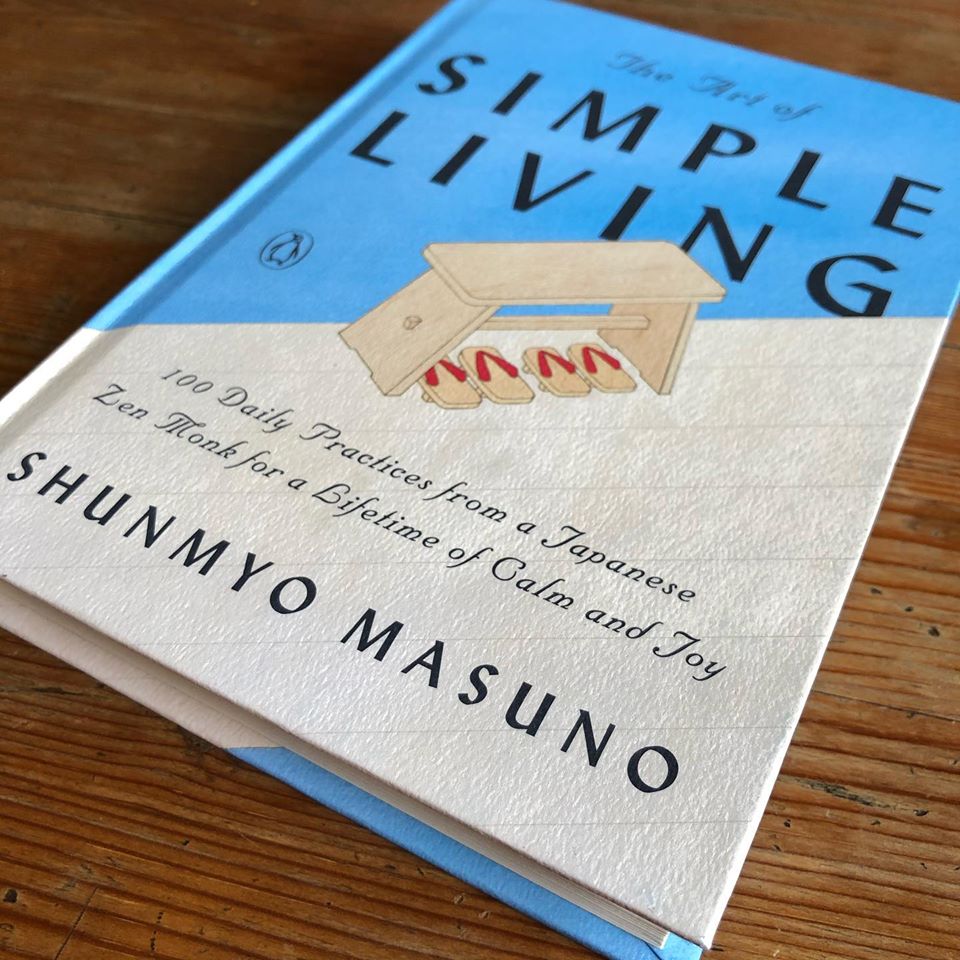
There is beauty and elegance in simplicity.  It’s no surprise that I am drawn to the work of a Zen monk and Zen gardener.  Despite having decided not to purchase any new book until I am done with a dozen of unread books accumulated from previous year, I couldn’t resist when I chanced upon The Art of Simple Living by Shunmyo Masuno.

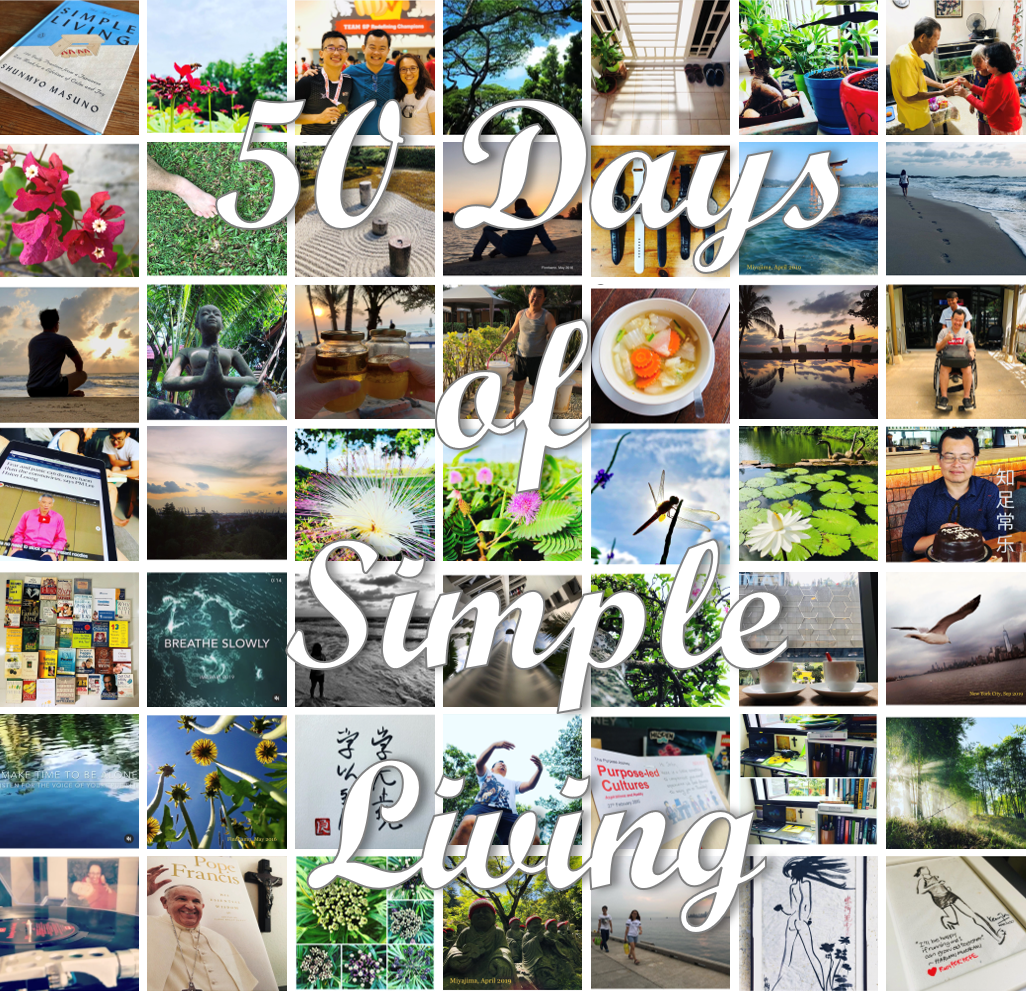
I used to devour books like a hungry teen at a buffet.  But this time, I decided to slow down and pause after every bite.  Exactly 50 days ago, on 19 January 2020, I set out on a #50DaysOfSimpleLiving challenge to fully immerse myself into Shunmyo’s ‘100 daily practices.’  Each day, I shared a couplet on Instagram and Facebook, and tried putting them into practice.

Here are my Top 10 daily Zen practices from 5o consecutive days of experimenting with Shunmyo’s Art of Simple Living and how they have impacted me.

01. Day #11: Try just sitting quietly in nature.  I’ve always loved nature, but have definitely spent a disproportionately high percentage of my life being seated in front of the laptop.  This has prompted me to make time to connect with both nature and with myself more regularly.  It has brought greater clarity of mind and deeper peace in my heart.

02. Day #13: Focus on others’ merits. I’ve been known to be ‘highly critical’ and focusing on others’ merits (instead of faults) has enhanced the harmony and relationship both at work and at home.

03. Day #14: Don’t put off what you can do today.  A perfect remedy for the ‘chronic procrastinator’ in me. This practice had fueled actions to get a few things done, including publishing Let’s Hack Learning

04. Day #17: Be here now.  I’ve known the importance of being present to the HERE and NOW, but certainly haven’t put that into practice enough.  I think I’m more present now, especially when listening to another.

05. Day #24: Do not be swayed by the opinions of others.  A timely advice when faced with a recent dilemma amidst the COVID-19 outbreak.  I learned about decisiveness and the ability to trust in myself.

06. Day 27: Be grateful for every day, even the most ordinary.  Gratitude is indeed a powerful practice found in many spiritual and cultural traditions.  This had deepened the practice that I have observed when experimenting with A Year of Living Gratefully in 2017.

07. Day 27: Make the most of Life.  I am reminded that what matters most is not how long we live, but how we use the Life we are given.  Borrowing the words of George Bernard Shaw, “I want to be thoroughly used up when I die.”

08. Day 34: Deepen your connection with someone.   Deep and meaningful relationships – that’s what I have always enjoyed.  I shall continue to do so, even with those whom I meet only once in my lifetime.

09. Day 43: Discard what you don’t need.  A very practical advice to simplify our lives.  I’m still working on my attachment to certain possessions and past experiences, but already enjoying the space created both physically and mentally from letting go of those that I am able to discard.

10. Day #50. Serve People.  Some friends have asked, “What happens after Day 50?”  Inspired by the words of wisdom from an old friend – “Being in service of another is a mutual gifting,”  I’ve decided to extend this final practice into the rest of the year with a next project: #50GoodHours.

I’m committing 50 hours of pro bono service to individuals seeking coaching, mentoring, or consultancy in the areas of personal development, leadership development, life transitions, and parenting.

If you know anyone or non-profit organisation (any where in the world) that I could be of service to, please have them contact me. Thanks for spreading the word. 🙏

The best way to find yourself is to lose yourself in the service of others. ~ Mahatma Gandhi

Why not check out The Art of Simple Living and find out for yourself how Shunmyo’s 100 daily practices could bring more simplicity, calm, and joy into your life?

Decisiveness is about having the ability to trust in yourself

“To go, or not to go?”  That’s the question that I have been wrestling with over the weekend.  As a consequence of COVID-19, all our face-to-face programmes with clients scheduled in February and March have been either postponed or replaced with virtual options, except two.

I was due to travel to Dubai next Monday, followed by Batam, Indonesia in late March.  Dubai will be my first overseas destination since the beginning of the outbreak.  Part of me yearns to return to ‘business as usual,’ get on with normal life, and carry  on with my work in leadership development.   Another cautious part wants to minimise non-essential travel so as to lower the risk of being infected or infecting others.  At present, there are more confirmed cases of infection in Singapore than UAE.  And I certainly don’t wish to be known as the guy who spread the virus to Dubai.

Confused and undecided, I chose the easy way out.   Instead of facing into the dilemma, I expressed my preference for postponement and left it to the client to decide.  Eventually, as the company put in place a ban on non-essential travel and that some participants would be travelling in from other middle-eastern countries, the workshop was postponed.

I was relieved, but somewhat disappointed with my cowardice.  Why hadn’t I just said ‘No’?

Then I thought of one of Shunmyo Masuno’s 100 Zen practices that I had previously shared on Day 24 of #50daysofsimpleliving:

75. DO NOT BE SWAYED BY THE OPINIONS OF OTHERS. The secret to breaking free from confusion … Decisiveness is about having the ability to trust in yourself.


This time, I trusted myself, and took courageous action.  I wrote to the CEO of the other client, shared my concerns openly, and recommended strongly to postpone the training in Batam.  I also expressed firmly my withdrawal from the engagement should they decide to proceed as planned.

I’m not going to Indonesia this March, no matter what the latest news or COVID-19 statistics may suggest. And I shall not be swayed by others’ opinions.

I made my stand and felt fully at peace. And the CEO responded shortly:

Dear Kenny,

Our policies are in line.
We just decided to postpone the school 2 hours ago. I will get back to you in the next days with proposals for new time slots.

Great minds think alike.  Looks like ‘business as usual’ is not about to return anytime soon, if it does, at all.

And I learnt my lesson on leading in uncertain times.   As much as rational and well-informed decisions are often preferred, in the absence of sufficient information, we still need to take a courageous stand.  Whether we choose to be guided by intuition or grounded on values, Masuno’s wisdom is worth heeding.

Decisiveness is about having the ability to trust in yourself.